

What Is a Blog Sales Funnel? How Blog Readers Turn Into Buyers
A blog sales funnel turns free search traffic into leads and sales: blog daily, get found on Google, send readers to a capture page, let a video explain, and let email follow up.

Sammy Beaugard
Disclosure: Some links in this post are my referral links. If you join through them, I may earn a commission at no extra cost to you.
A blog sales funnel is a simple path that turns a stranger who finds your blog on Google into a lead on your email list, and then into a customer. You write helpful posts, search engines send you free readers, a link in each post takes them to a capture page, a short video explains your offer, and your emails follow up until they're ready to decide.
That's the whole idea. Each step has one job, and no step has to do everything by itself.
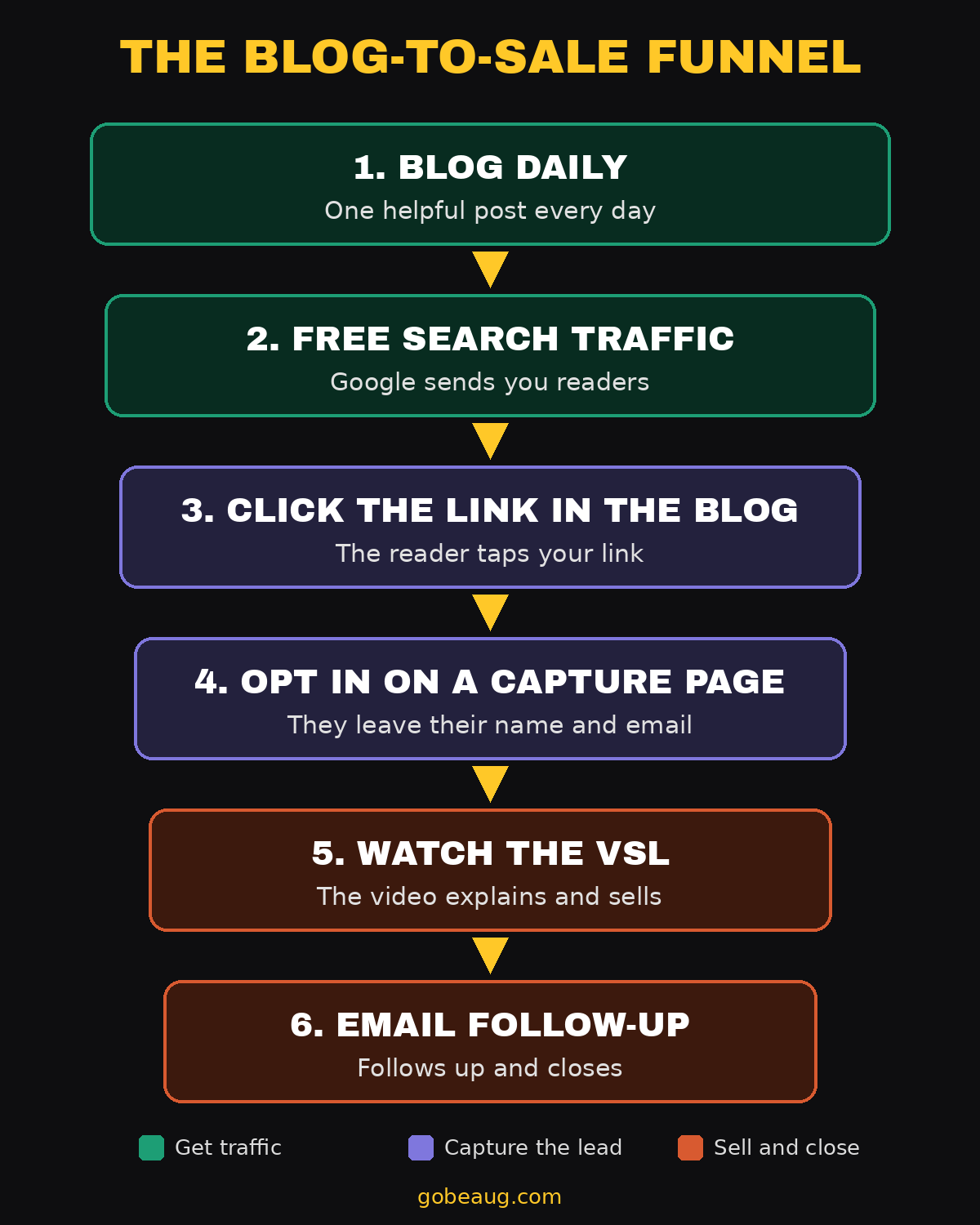
Here's each step in plain English.
Step 1: Blog daily
Everything starts with content. Every post you publish is one more page that can show up when someone searches for help.
The key is to write about problems people actually type into Google, in their own words. "How do I build an email list for free" will get found. "My amazing opportunity" won't, because nobody searches for that.
Why daily? Because each post is another door into your business. One post is one door. A hundred posts are a hundred doors. Daily is the goal, but if you can only do three a week, do three a week. Consistency beats bursts.
Step 2: Free search traffic
When your posts answer real questions well, Google and other search engines start showing them to people. That's free traffic: you don't pay for the click, and a good post can keep getting visitors for months or years.
Be honest with yourself about the timeline. Search traffic is slow at first. It often takes weeks or months before a new blog gets steady visitors, and some posts never rank. That's normal. Keep publishing.
Step 3: The reader clicks the link in your blog
Every post should have a clear next step. Not ten links, one main one. Something like "Get my free guide" or "Watch the free video" works far better than "Click here to make money."
Put it where it fits naturally: once near the top, once in the middle if it helps, and once at the end. The reader came for an answer. Give them the answer first, then offer the next step.
Step 4: They opt in on a lead capture page
The link takes them to a lead capture page (also called a squeeze page or opt-in page). It has one job: get their name and email in exchange for something useful, like a free video or guide.
This is the most important step in the funnel. A blog visitor might leave and never come back. A lead on your email list is someone you can talk to again and again. That's why people say "the money is in the list." The list itself doesn't make money; the relationship you build with it does.
A good capture page is short: a clear headline, one or two lines about what they get, the form, and a button. No menus, no distractions.
Step 5: The VSL does the selling
After they opt in, send them straight to a VSL, a video sales letter. It's a short video that tells the story, explains the offer, answers common questions, and shows them how to get started.
The video does the explaining for you. Instead of repeating yourself in a hundred DMs, you explain it once, really well, and every new lead gets the same clear presentation. Keep it honest: what it is, who it's for, what it costs, and that results vary.
Step 6: Email follow-up does the closing
Most people won't buy the first time they see an offer. They're busy, unsure, or just not ready. That's where email follow-up comes in.
An autoresponder sends a series of emails over the following days and weeks. Each one is a short, helpful reminder: a tip, a story, an answer to a common question, and a link back to the video. Over time, those emails build trust, and the people who are a good fit decide when they're ready.
This is the part that works while you sleep. You write the emails once, and they go out to every new lead automatically.
Why this funnel works
- Each step has one job. The blog brings readers, the capture page gets the email, the video explains, the emails follow up.
- It builds on itself. Every post you write keeps working, and every lead you capture stays on your list.
- It's not pushy. You help first, then offer. People who buy have had time to learn and decide.
- You own it. Your blog and your email list are yours. A social app can change its rules, but your list stays with you.
Common mistakes to avoid
- Sending blog readers straight to a sales page. Capture the email first, or most visitors are gone forever.
- Writing about your offer instead of their problem. Nobody searches for your product's name until they've heard of it.
- No follow-up. A list with no emails going out is just a spreadsheet.
- Quitting too early. Blog traffic grows slowly. The people who keep posting are the ones who see it build.
Do I need all of this to start?
No. You can start with just a blog and one free capture page, then add the video and emails as you go. What matters is that every piece points to the next one.
I built GoBeaug so the pieces live in one place: a blog, a link page, capture pages and follow-up emails that work together, so you're not stitching five tools together by hand. Check the current details on the site.
Your next step
Look at your own setup and ask: if a stranger found my blog today, where would they go next? If the answer is "nowhere," start with step 4. Add one capture page and one link at the end of your best post.
Which step of the funnel are you missing right now? Tell me in the comments.
Results vary. Your results depend on your own effort, skills and situation, and many people earn nothing.
Keep reading
- Leads and EmailWhat Is a Lead Magnet? A Plain-English Answer for Beginners
A lead magnet is a free, useful item you trade for an email address. Here is how it works, simple beginner examples, and how to make one with no money.
- Leads and EmailWhy Do Affiliate Marketers Build an Email List?
Affiliate marketers build email lists because social followers can vanish overnight, but a list lets you follow up and keep in touch with people you own.
- Automated ToolboxWhy I Moved My Email List to Automated Toolbox
I lost my whole contact list once when a company shut down. Here is why I now run every capture page and follow-up email through Automated Toolbox.
- Affiliate Marketing for BeginnersSix Figures in 12 Months? What It Really Takes (The Honest Math)
The honest math behind six figures in 12 months with $500 instant commissions: how many sales it takes, how pass-ups work, and the daily routine behind it.


Loading comments…